

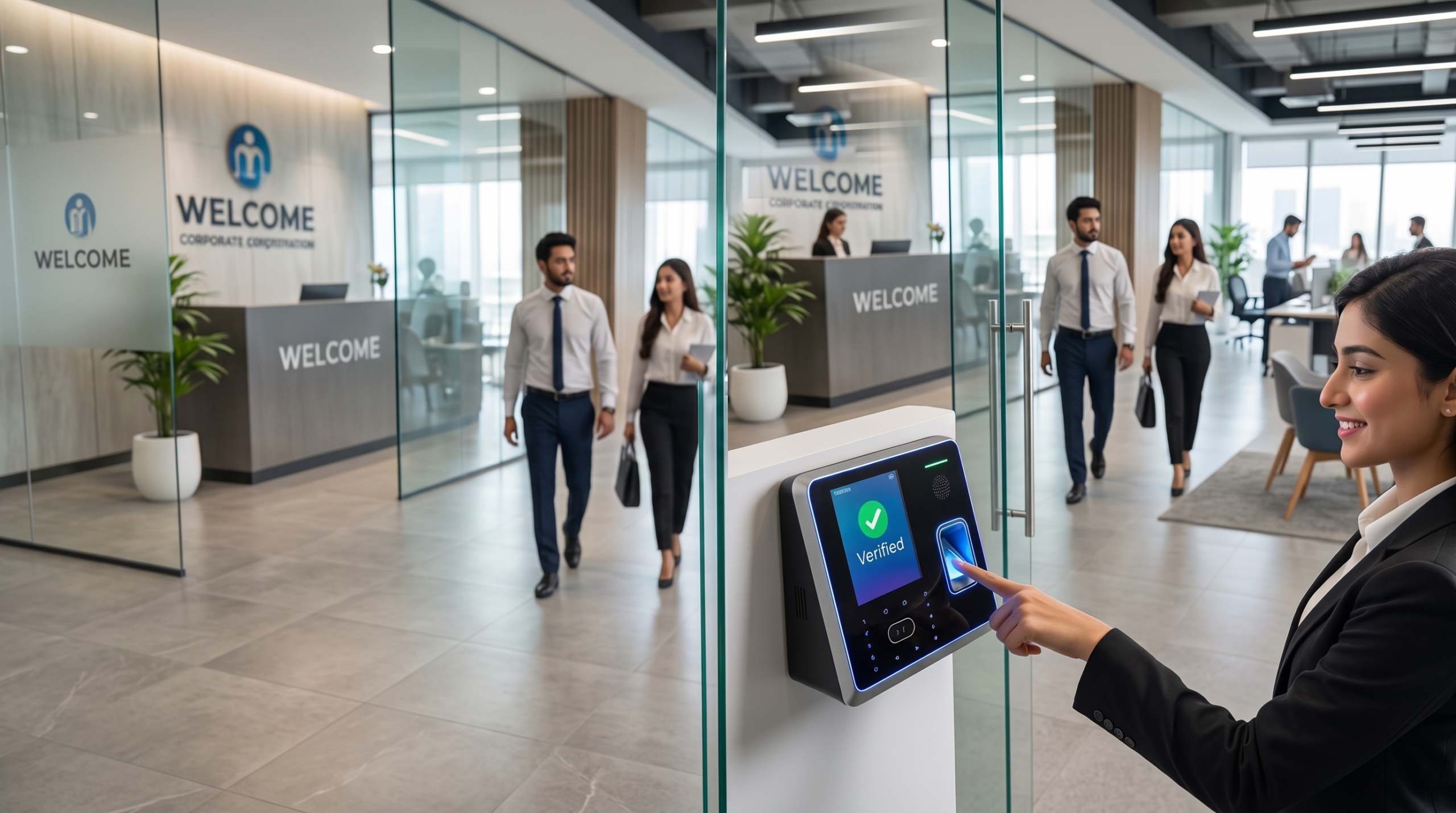
A modern Attendance Sheet Format is no longer a paper register or an Employee Attendance Sheet in Excel. Businesses now pair a Biometric Attendance System with a connected Time and Attendance System to automate Employee Attendance Tracking, improve payroll accuracy, and remove manual reconciliation. Instead of collecting signatures at the front desk, companies get real-time visibility into Workforce Management. The result is a faster, more secure employee experience from the moment someone walks through the door.
How many hours does your team lose every month because someone is still signing an attendance register with a pen?
Offices still running on paper hit the same reception bottleneck every 9 A.M., even as biometric systems now run the front desk next door. A queue backed up around a single register and a pen that goes missing at least once a week. Employees wait their turn to sign a register already smudged with yesterday’s ink, while visitors behind them fill out the same slips that piled up unchecked the day before.
The security guard flips back a page or two, squinting to match names against handwriting nobody can quite read anymore. Someone forgets to sign out again, and payroll spends half the next week chasing corrections that should not exist in the first place. HR ends up playing detective over five extra minutes that were never logged correctly. This outdated Attendance Sheet Format does not just slow the morning down. It quietly costs more than most managers ever bother to track.
Picture a different morning entirely. Employees walk past reception and their attendance logs before they even reach their desks. No queue. No pen. No missing signature to chase down at 5 P.M. Businesses across Pakistan are quietly rebuilding this daily routine through automation, turning what used to be a morning chore into something nobody thinks about anymore. That shift does not start with buying software. It starts with rethinking how Employee Attendance Tracking actually happens on the ground, one entry point at a time, long before a single vendor is ever contacted.
The Reception Everyone Notices Starts With Better Attendance
A professional workplace begins the moment someone walks through the entrance, not when the meeting starts. Replacing a manual attendance sheet format removes those first few awkward minutes of waiting and swaps the paper employee attendance sheet for something visitors barely notice. People notice more than most companies realize.
First impressions shape trust before anyone has said a word. A cluttered reception desk with a worn, coffee-ringed register signals disorganization, even when the rest of the office runs like clockwork. A quiet, automated entry signals control instead, and it does that within the first ten seconds someone walks in.
- Faster employee entry without waiting in line
- A cleaner, less cluttered reception area
- Stronger visitor confidence from the first handshake
- Less administrative work for front desk staff
A better entry does not just look good on a visitor’s first day. It removes friction that slows down the rest of the operation.
Every Clock-In Creates Better Business Decisions
Accurate attendance records help managers plan staffing, payroll, and productivity with more confidence. A modern time and attendance system turns every clock-in into a data point instead of a signature on paper.
Real-time employee attendance tracking changes how operations teams plan the week. Shift planning gets easier when managers see who is present without calling the front desk. Payroll preparation moves faster because hours are already logged and confirmed.
Overtime becomes visible before it turns into a dispute. Employee time tracking data lets department heads pull reports without waiting on HR to compile a spreadsheet—these small shifts save hours across a single pay cycle.
The Future Runs on Verification Instead of Signatures
Paper signatures get forgotten, duplicated, or filled in later. Digital verification creates reliable attendance records the moment employees arrive at work.
A Biometric Attendance System replaces a signature with actual proof of identity. Fingerprint scanning, facial recognition, and QR authentication all confirm identity in under two seconds. Contactless verification means no one touches a shared pen or scanner again.
Verification matters more than recording ever did. A record only proves someone was marked present that day. Verification proves the right person actually walked through the door.
Small Daily Delays Become Big Operational Costs
A few minutes lost every morning become hundreds of working hours over a year. Many businesses still track hours with an employee attendance sheet in Excel, copying numbers by hand into payroll every month.
Manual attendance carries hidden costs that rarely show up on a single day’s report.
- Manual reconciliation between the register and payroll sheet
- Attendance corrections that pull HR away from other work
- Payroll disputes over missed or unclear entries
- Late reporting that delays management decisions
Employee time tracking removes most of these costs by capturing accurate data the first time. There is nothing left to reconcile at the end of the month, and nothing left for HR to chase.
The Smartest Offices Quietly Removed the Register
Leading organizations are simplifying attendance instead of adding more administration. Employees expect a digital experience at work the same way they expect it everywhere else.
Hybrid work has raised the bar for consistency across every team. A workforce split between office and remote days needs consistent workforce management and attendance records that stay accurate regardless of location. A paper register cannot keep up with that pace.
Companies looking for a smoother way to track presence often adopt FlowFiz’s Biometric Attendance Solutions, which pairs a one-stop Biometric Attendance System with real-time reporting after they define what their operations actually need. It becomes a natural next step, not a sales decision forced by a vendor.
Choosing the Next Quarter Instead of Another Busy Monday
Organizations usually delay attendance modernization until inefficiencies become impossible to ignore. Planning the transition now avoids another year of manual work and repeated payroll disputes.
Implementation does not need to happen overnight. A phased rollout lets employees adjust gradually while HR monitors adoption closely. Most teams reach full comfort with new time-tracking software and a fresh attendance sheet format within a few weeks.
Imagine Next Quarter Starting Without Paper Attendance
Imagine your front desk three months from now: no register, no queue, no end-of-month scramble to reconcile hours.
A better Attendance Sheet Format delivers more than convenience alone. It replaces the old Employee Attendance Sheet with reliable records, a connected Time and Attendance System, faster payroll preparation, and real visibility across your entire Biometric Attendance System rollout.
The businesses that make this shift now will spend next quarter focused on growth instead of chasing signatures.
Frequently Asked Questions
Can an Attendance Sheet Format be completely replaced?
Yes. Modern attendance solutions replace manual registers entirely while keeping records more accurate and easier to audit.
Is a Biometric Attendance System suitable for growing businesses?
Yes. It scales easily as headcount grows, without adding administrative work for HR.
Does Employee Attendance Tracking improve payroll accuracy?
Yes. Verified, real-time data removes the manual errors that come from paper registers and spreadsheets.