

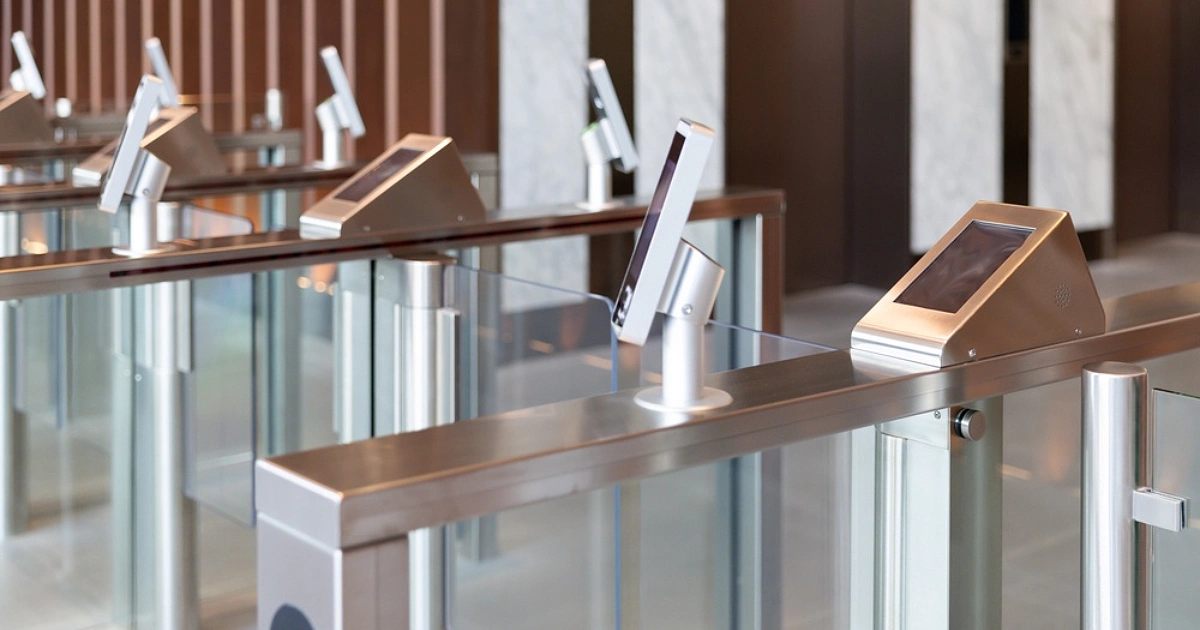
| Quick Answer: Smart security gates prevent tailgating by enforcing a one-person-per-credential rule at the physical entry point. Infrared sensors count heat signatures on every gate cycle. When a second signature appears on a single badge scan, the gate closes in under 500 milliseconds. Anti-passback logic then locks out that credential until a valid exit is recorded in the access control system. Every attempt is timestamped and automatically linked to camera footage. |
An employee badges into your office lobby during the morning rush. The barrier opens smoothly.
Before the panel can glide shut, a stranger slips in right behind them. Your facility now faces an active security breach past your first physical line of defense.
Still, the most often attacked weak spots in corporate perimeters are tailgating and piggybacking. Automated enforcement is necessary to control these hazards.
Modern smart security gates serve as a critical physical access control solution. This guide explains how these systems detect breaches, secure busy entrances, and help Pakistani businesses select the proper physical hurdles for long-term facility security.
What Is Tailgating in Physical Security? (And Why Should You Care?)
Tailgating is the act of an unapproved person following an approved person closely through a locked doorway without providing identification. Though piggybacking entails conspiracy, it differs somewhat.
In a piggybacking situation, an employee deliberately holds a door open for a visitor who hasn’t been checked in. Both actions result in failures of unauthorized entry prevention that compromise internal assets.
According to global security deployment surveys by organizations like ASIS International, a massive 93% of enterprise security professionals report experiencing physical access breaches. Tailgating is the top entry vector for these incidents.
Relying purely on human guards to watch every controlled pedestrian entry point leads to fatigue and operational oversight during shift changes or peak morning crowds.
How do security gates prevent tailgating and Unauthorized Entry
Deploying smart security gates changes your security posture from passive monitoring to active enforcement. These systems integrate advanced entry authentication mechanisms directly into physical barriers.
1. They Enforce One Person Per Credential Entry
The core function of a physical access control gate is ensuring that a single valid scan allows precisely one person to walk through. When a worker presents a card or mobile token, the gate opens for a single cycle.
It immediately resets its automatic locking mechanism as soon as that specific individual clears the lane. This action stops the next person in line from entering without a scan.
2. They Use Physical Barriers to Block Extra Entry
Standard doors stay open long enough for multiple people to pass through. Smart security gates for businesses use specialized hardware barriers to physically close off the remaining walking space.
Depending on the gate design, these barriers utilize mechanical tripod arms, retracting glass flaps, rugged swing panels, or ceiling-high steel rotors.
3. They Use Sensors to Detect Multiple People
Modern speed lanes embed sophisticated infrared sensor arrays and optical emitters across both sides of the passage zone. These sensors map the physical space inside the lane.
When the system identifies two distinct bodies traveling on one approved scan, it immediately raises an anti-tailgating security entrance infringement.
Advanced configurations use 3D depth sensors to differentiate between one person carrying heavy bags and two different individuals trying to sneak past simultaneously.
4. They Validate Credentials Before Opening
A smart gate remains locked until it receives a direct authorization command from your connected identity management hardware. Enterprises can natively mount several authentication systems to the chassis.
Options include secure RFID proximity cards, dynamic mobile QR codes, and high-speed biometric attendance devices.
Organizations can also use precise fingerprint devices or contactless facial recognition devices for quick entry authentication validation.
5. They Reset or Re-Lock After Each Valid Passage
The moment the infrared sensors confirm that the authorized user has safely stepped out of the lane, the gate closes in under 500 milliseconds.
This rapid physical response eliminates the open-door window that tailgaters rely on to gain entry.
6. They Trigger Alarms for Suspicious Entry Attempts
If a tailgating event occurs, the system does more than just block the path. It instantly activates local audible alarms and flashes red LED indicators on the gate chassis to assure security breach prevention.
The system also pushes high-priority visual alerts to the guard desk or central control room.
7. They Create Access Logs and Audit Trails
Every single entry, denied scan, sensor alarm, and tailgating violation generates a detailed digital timestamp.
ASIS International physical security standards require documented access control at sensitive entry points. Smart security gates automatically produce a complete audit trail. SOC 2 assessors and ISO 27001 auditors accept this log as evidence of enforcement. No manual reporting is needed.
8. They Integrate with CCTV and Visitor Management Systems
When sensors flag an unverified entry attempt, the gate can send an automated trigger to your CCTV attendance device.
This action immediately triggers nearby security cameras to record high-resolution footage of the violator for rapid security breach prevention.
9. They Reduce Dependence on Manual Security Checks
Human guards remain essential for incident response and visitor handling, but they cannot perfectly police every high-traffic entrance during peak hours.
Smart gates handle the repetitive work of individual verification. This frees your personnel to focus on higher-value monitoring tasks.
Whether you need automated access control for anti-tailgating, or customized security gate options, feel free to get in touch with our team.
Types of Security Gates and Their Anti-Tailgating Capability
Different building layouts and risk profiles require distinct barrier types. Understanding the mechanical differences helps ensure your hardware selections align with your facility goals.
Tripod Turnstiles
Tripod turnstiles feature a classic three-arm rotating design that permits entry only when a user physically pushes past the bar. The mechanical design naturally restricts movement to one person per credential per rotation.
These gates are durable and highly efficient, and work great in rough industrial environments. This hardware helps save installation costs over time and provides dependable operation for heavy daily use.
Best for: Manufacturing plants, busy factories, construction sites, and employee attendance tracking.
Full-Height Turnstiles
Full-height turnstiles extend completely from the floor to the ceiling. This creates a strong steel barrier. Intruders cannot climb over or crawl under this system. It offers the best protection for secure areas.
Best for: Industrial yards, storage facilities, outdoor perimeters, and data centers.
Flap Barriers (Speed Gates)
Flap barriers utilize motorized acrylic or glass wings that quickly retract into the main housing upon credential approval. They feature high sensor density to safely spot tailgaters and close before the second person can squeeze past. They combine rapid closure speeds with high-density tracking sensors.
Best for: Premium corporate offices, modern lobbies, co-working spaces, and commercial high-rises.
Swing Barriers
Swing barriers use elegant motorized panels that open outward like a traditional door. They provide wider lane configurations, making them ideal for moving large items or meeting accessibility standards. They balance modern design with necessary pedestrian access compliance.
Best for: VIP reception entrances, main hospital corridors, and public facility lobbies requiring wheelchair access.
Comparison Table: Smart Security Gates for Tailgating Prevention
| Gate Type | Tailgating Protection | Throughput Speed | Primary Target Environment |
| Tripod Turnstile | Moderate to High | 25–30 Persons / Min | Industrial Plants, Production Factories, Gyms |
| Full-Height Turnstile | Maximum | 15–20 Persons / Min | Data Centers, Power Plants, Secure Storage Yards |
| Flap Barrier | High | 35–40 Persons / Min | Enterprise Headquarters, Bank Lobbies, Airports |
| Swing Barrier | Moderate | 30–35 Persons / Min | Wheelchair Lanes, Executive Receptions, Hospitals |
Where Are Smart Security Gates Most Needed? (Industry Use Cases)
Smart security gates for businesses address different risks depending on the sector. Here is where controlled pedestrian entry delivers the most direct value across Pakistan’s key industries.
Offices and Corporate Buildings: Employee-only areas requiring confirmed access on every entry attempt include server rooms, accounting departments, and executive floors. Gates enforce this without placing a guard at each internal door.
Factories and Industrial Facilities: Shift control and headcount accuracy depend on knowing exactly who is on the floor at any time. Anti-tailgating security gates ensure that every recorded entry belongs to a verified person.
Schools and Universities: Student safety depends on knowing who is inside the campus perimeter during school hours. Gates with visitor pass integration allow controlled pedestrian entry for authorized visitors. Unregistered individuals are denied at the barrier.
Banks and Financial Institutions: Vault areas, data rooms, and restricted floors carry regulatory and liability exposure when accessed by unauthorized individuals. Gate-level enforcement creates the audit trail that compliance teams and regulators require.
Hospitals and Healthcare Facilities: Medication stores and patient-only areas require access control that holds up under inspection. Prevention of security breaches at these points is both a safety obligation and a regulatory requirement.
Residential Buildings and Gated Communities: Restricts clubhouse floors and internal pedestrian pathways to verified residents only. Reliance on one gatehouse guard is eliminated by smart security gates, which instead employ a system that automatically checks every entry and permanently records it.
Frequently Asked Questions
Which turnstile is best for preventing tailgating?
Because of their floor-to-ceiling design, which prevents crawling or climbing bypasses, full-height turnstiles provide the greatest degree of physical tailgating prevention. For indoor corporate settings, flap-barrier speed gates are preferred because they combine rapid closure speeds with high-density tracking sensors.
Can a security gate work without the internet?
Yes, modern smart gates operate reliably without an active internet connection. The physical barriers store access privileges locally on internal control boards, allowing them to validate credentials, process sensor data, and open lanes during network outages.
How do anti-tailgating sensors work?
Anti-tailgating systems use multiple infrared beam arrays positioned along the inside of the lane. These beams measure the physical space and break sequences as users walk through. If the beam-break pattern indicates two distinct profiles walking on a single scan, the gate triggers its alarm.
Are smart security gates better than normal doors?
Smart gates are vastly superior for a high-traffic entrance. A standard door swings open and remains unmonitored for several seconds, allowing multiple people to walk past. A smart gate manages every individual opening cycle based on real-time sensor feedback.
Can smart security gates connect with biometric systems?
Yes, most smart security gates for businesses integrate with face, fingerprint, and iris scanner hardware via standard wiring connections. This connects physical barrier access directly to distinct biological signatures for businesses.
Do smart security gates work in high-traffic areas?
Yes, modern speed lanes are engineered for a high-traffic entrance, processing up to 40 verified individuals per minute. This high rate prevents pedestrian bottlenecks from forming in the main lobbies during morning rush hours.
Can smart gates record entry logs?
Yes, every gate action generates a localized log file containing the precise time, user ID card number, and entry status. These files can sync directly to your central HR software or security management database.
Conclusion
Tailgating is a solved problem at the hardware level. Smart security gates enforce one verified entry per credential at the physical barrier. Your access control systems handle identity logic. The gate handles physical enforcement. The audit trail handles compliance documentation.
Organizations that deploy smart security gates reduce guarding costs, satisfy regulatory auditors, and eliminate the most exploited gap in enterprise physical security.The right gate specification starts with your facility’s risk profile and throughput requirements. Reach out to FlowFiz to discuss the right option for your property.