

| Quick Answer: Turnstile gates are physical access barriers that allow one authorized person through at a time. They verify credentials like RFID cards, fingerprints, or facial scans before unlocking. Businesses use them to block unauthorized entry, stop tailgating, and automate attendance tracking. Common types include tripod turnstiles, full-height turnstiles, flap barriers, swing barriers, and speed gates. |
It’s 8:45 AM. Your facility has 300 employees streaming in for the morning shift. There’s one security guard at the entrance, people are holding the door open for each other, and nobody’s actually sure who came in and when.
That’s not security. That’s chaos with a uniform standing next to it.
Someone clocked in with their cousin. Three people walked through on one card swipe. A contractor entered a restricted area because no one stopped him. And your attendance sheet for the day? Complete fiction.
If any of that sounds familiar, you already understand why businesses switch to turnstile gates. This guide covers what turnstile gates are, the different types of turnstiles available, and how turnstile gates work in real environments. We’ll also get into which industries use them and what to look for before you buy.
What Is a Turnstile Gate?
A turnstile gate is an access control system installed at an entry point. It holds its position until a valid credential comes through, a card tap, a fingerprint, a face scan, whatever your system runs on. Only then does it move.
It’s built specifically to allow one person through per authentication. Two people cannot pass on one approval. That single design principle is what makes it effective against tailgating.
Today’s systems go further. They connect with biometric attendance devices, HR software, and CCTV attendance platforms, turning every gate interaction into an automatic attendance record. No paper logs. No manual entry.
One-Way vs. Bi-Directional Turnstiles
One-way turnstiles control movement in a single direction. Subway gates, event entries, loading checkpoints, anywhere you only need to manage who comes in.
Bi-directional ones handle both directions in the same lane, which is why most offices use them. Staff come and go throughout the day, and running separate lanes for entry and exit rarely makes practical sense.
Manual vs. Fully Automated Turnstiles
With a manual turnstile, a guard physically releases the gate after checking a person. It can work, but you’re building your whole access system around human consistency, and that’s not always reliable during a busy shift change or a quiet late night.
Fully automated turnstiles handle it without anyone at the door. The credential gets checked, the gate opens or stays shut, and the log updates on its own.
The Key Components of Turnstiles
Four components determine how well a turnstile gate performs in daily use.
Frame and Housing: The outer body takes the most physical wear. Cheaper frames look identical on a product page but start showing their age within a year, particularly on outdoor sites or in industrial environments.
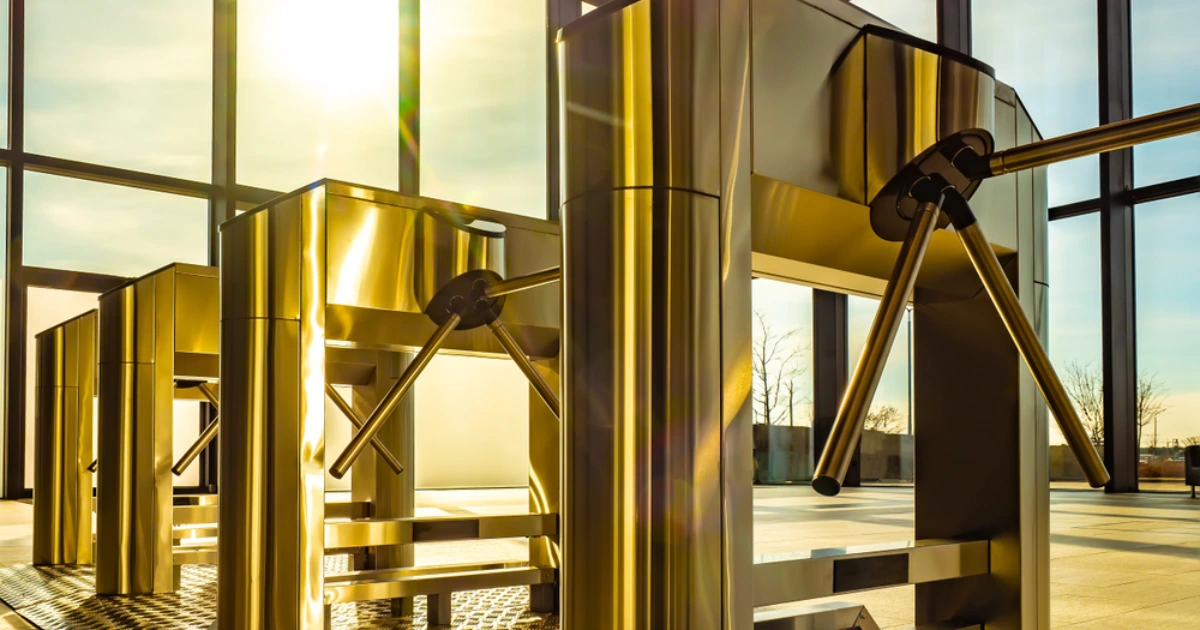
Arms or Barrier Panels: These are the physical barriers across the lane. Tripod turnstiles rotate on three arms. Whereas flap barriers use slim retractable panels, and full-height turnstiles enclose the passage completely. What you pick here is effectively picking your security level.
Control Module: It processes the credential data and sends the unlock signal. This makes it the core of the system. A weak control module means slower processing, more errors, and higher maintenance costs over time.
Credential Reader: The reader captures identity at the entry point. Depending on the setup, this is an RFID reader, fingerprint scanner, facial recognition camera, or QR code scanner. Your choice of reader shapes the entire user experience at the gate.
How Do Turnstile Gates Work?
The actual mechanics are simple, which is one reason they hold up so well over time.
How do turnstile gates work, step by step:
- Person walks up and presents their credential (card, fingerprint, face, phone, or QR code)
- The reader captures the data and passes it to the control module
- The control module checks it against the approved list
- The gate opens on a match. Stay shut otherwise.
- One person walks through
- Entry or exit gets logged with a timestamp
- Gate resets for whoever’s next
On a properly set-up system, that whole sequence runs in about 0.3 to 0.5 seconds. Sounds quick. But put 200 factory workers in front of a sluggish gate at shift start, and you’ll very quickly care about those extra milliseconds.
Common Authentication Methods
RFID cards are where most businesses start. Staff tap, they’re in. Dead simple. When someone loses a card or leaves the company, you deactivate it remotely. Done.
Fingerprint scanners connect with fingerprint devices at the gate. Card-sharing is the main reason businesses upgrade to these systems. If your staff have been covering for each other, fingerprint access stops that on day one.
Facial recognition is the cleanest experience for staff. Walk up, gate opens. Nothing to carry or remember. It’s especially common in food manufacturing factories and hospitals, where touching shared surfaces poses a real risk.
QR codes are for people who aren’t on your permanent roster, such as visitors, contractors, and delivery staff. Generate a code, set expiry, and move on.
Mobile access is growing fast in offices. Most people are already glued to their phones for everything else. Using it to enter the building is a natural fit.
How Do Turnstile Gates Integrate With Attendance and Access Control Systems?
A turnstile running on its own controls access. One connected to your wider systems does considerably more.
Linked to fingerprint attendance machines, facial recognition terminals, CCTV attendance cameras, and HR payroll software, every gate entry becomes a verified attendance record. Payroll runs on confirmed data. HR gets accurate logs without manual input. Management sees real-time headcounts without calling anyone.
Types of Turnstile Gates Explained
This is where most buying decisions go sideways. People pick a type based on what looks good in a brochure rather than what actually fits their site. Here are the main types of turnstiles worth knowing:
- Tripod Turnstile: Your most affordable entry point for high-traffic sites. Reliable where volume matters more than aesthetics.
- Full-Height Turnstile: Seals your lane completely, making tailgating physically impossible. Use it wherever an unauthorized entry carries real consequences.
- Flap Barrier Turnstile: Keeps your foot traffic moving without compromising your lobby’s appearance. Ideal when your entrance needs to look as good as it performs.
- Drop Arm Turnstile: Fits cleanly into your staffed reception or internal checkpoints. Choose it when a tripod would visually overpower the space.
- Swing Barrier Turnstile: Handles wheelchairs, bulky equipment, and high footfall in your facility. If your layout excludes it, you’re likely short on accessibility compliance.
- Optical Turnstile: Flags unauthorized entry instantly, but only works when your security staff is present to act. Deploy it unmanned, and you’ve paid a premium for noise.
Turnstile Gate Usage by Industry
Turnstile gate usage isn’t one-size-fits-all. Here’s how it actually plays out in different sectors:
Corporate offices use them mainly for two reasons: keeping visitors out of areas they shouldn’t be in, and getting clean attendance data without someone manually managing a register every morning. Both problems were solved at the door.
Factories and industrial sites are where turnstile gates tend to have the biggest impact. With hundreds of workers moving through multiple shifts a day, manual tracking simply can’t keep up. Restricted zones, shift tracking, contractor access; it all automatically runs through a single system.
Schools and universities were managing student movement manually for a long time. On a campus with thousands of daily entries, that stopped making sense. Turnstile systems handle the logging without adding administrative work.
Hospitals face specific challenges with sensitive departments and shift-based staff. Turnstile gate usage here covers visitor management and staff attendance in a single system.
Commercial buildings and shopping centers need to move large volumes of people quickly without losing track of occupancy numbers. High-speed flap barriers are usually the right fit here.
Government buildings and high-security sites don’t have much flexibility in access policy. Full-height or biometric-integrated turnstiles are the standard because anything less creates gaps that the policy doesn’t allow.
Comparison Table: Which Turnstile Gate Should You Choose?
| Type | Security Level | Speed | Fits Best |
|---|---|---|---|
| Tripod | Medium | Medium | Offices, gyms, schools, and factories |
| Full-Height | High | Medium | Warehouses, industrial sites, restricted zones |
| Flap Barrier | Medium-High | Fast | Corporate lobbies, commercial buildings |
| Drop Arm | Medium | Medium | Reception desks, internal access points |
| Swing Barrier | Medium | Fast | Hospitals, universities, accessible lanes |
| Optical | Medium | Very Fast | Staffed reception areas |
What Businesses Actually Notice After Installation
Tailgating disappears almost immediately. Physical barriers close the gap that a guard watching a door can never fully manage. A study on access control systems shows that unauthorized entries of this kind frequently go undetected and unrecorded unless a physical barrier or sensor is in place to catch them.
Attendance records become accurate by default. Every entry is logged automatically. Month-end reconciliation stops being a headache. Research on automated attendance systems has shown measurable improvements in both tracking accuracy and administrative efficiency. Switching to automated gate logging assures you never see the issue at your desk in the first place.
Visitor management gets a lot cleaner, too. Temporary access with defined time windows and full movement logs for compliance or audit purposes.
Important Features to Look for Before Buying a Turnstile Gate
Security level fit. An optical turnstile at a warehouse is not adequate. A full-height turnstile at a small reception area is more than you need and will frustrate staff daily. Match the gate to your actual risk level, not the most impressive-looking option in the catalogue.
Peak traffic volume. Think about your busiest moment of the day, not your average. A gate that handles 50 people per hour will bottleneck severely when 200 show up at shift start. Spec for your peak, not your mean.
Indoor vs. outdoor placement. Gates going outside need weatherproof housing and materials that won’t corrode. Check the IP rating before you buy, because finding out it wasn’t rated for your environment after installation is an expensive lesson.
Integration with your existing setup. Will it actually connect with your biometric attendance machines, RFID readers, or HR software? Don’t assume. Verify. Fixing integration mismatches after installation costs more than sorting it out up front.
Anti-tailgating sensors. If two people try to get through on a single credential, the gate should catch it. This should be standard on any serious installation, not an add-on you have to request separately.
Emergency fail-open. During a fire alarm or power cut, the gate must unlock automatically. Non-negotiable from a safety and compliance standpoint.
Accessible lane. If anyone in your building uses a wheelchair or regularly moves equipment through, you need at least one swing barrier lane. Skip it, and you’re likely out of compliance before the gate is even fully installed.
After-sales support. A gate that breaks down with no local support behind it is worse than not having one. Find out who services the hardware in your city before you sign anything.
Frequently Asked Questions
Which type works best for a corporate office?
Nine times out of ten, flap barriers. They’re fast, they look right in a professional environment, and they handle high daily volume without creating queues. Tripod turnstiles are the budget-conscious alternative for smaller offices where aesthetics aren’t the priority.
Can these systems tie into attendance software?
Yes, and for most businesses, that’s the main reason they make the switch. Modern turnstile gates connect directly with biometric attendance machines, facial recognition terminals, and RFID systems. Every entry creates an attendance log automatically, no keyboard involved.
Do they work outdoors?
Many models are purpose-built for outdoor use, but you need to check the IP rating for your specific site. A unit rated for a covered parking entrance may not hold up on an exposed factory gate. Get this confirmed in writing before purchasing.
What’s the difference between a turnstile and a speed gate?
A turnstile uses physical rotating arms or panels. A speed gate uses fast-retracting slim glass barriers designed for very high-traffic environments where speed is the priority. Speed gates are quicker and more expensive. For most standard business applications, a quality flap barrier does the same job.
Do they actually stop tailgating?
Yes, if anti-tailgating sensors are part of the spec. Without them, a determined person can still follow someone through. With them, the second body triggers an immediate lockout or alert. Make sure sensors are included before you finalize any order.
Final Words
Most businesses that install turnstile gates say the same thing afterward. They should have done it sooner. Not because the technology is impressive, but because a specific, daily operational problem simply stops.
The access logs are accurate. The attendance data is clean. The morning shift change stops being something the security team dreads.
What it comes down to is matching the right type to your actual situation: your daily headcount, your security requirements, and what software you’re already running. Get that right and everything else follows.Ready to sort this out for your site? Get in touch with the Flowfiz team today. We work with businesses across Pakistan on access control and attendance setups, and we’ll help you figure out exactly what fits, without overcomplicating it.