

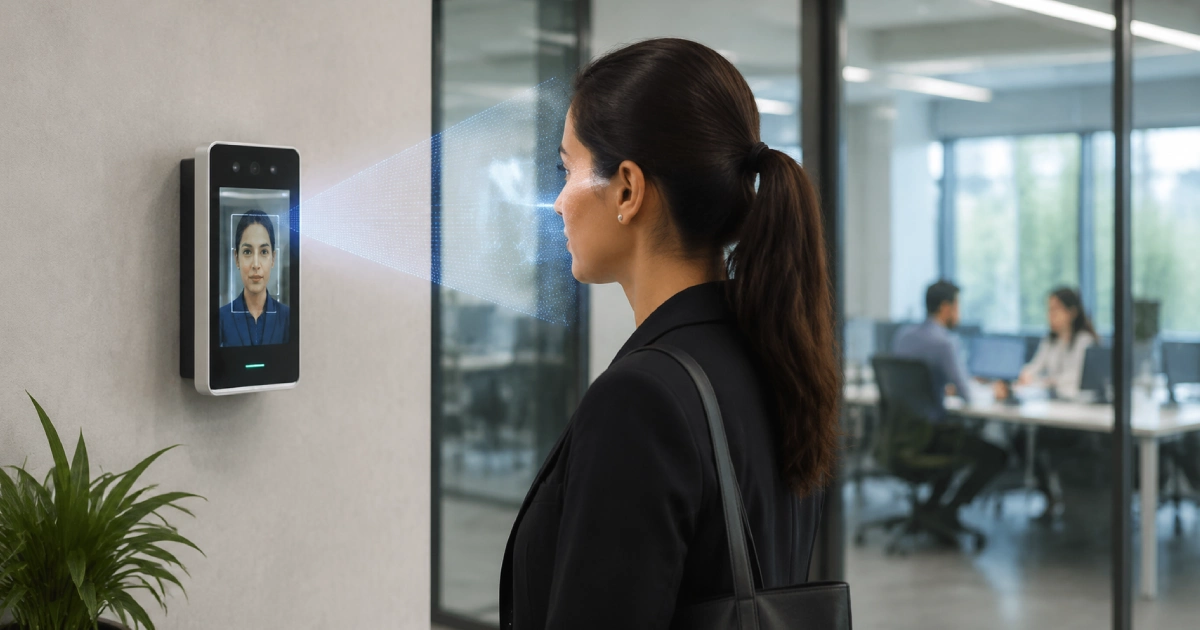
| Quick Answer: A face recognition attendance system is an AI-powered device that scans an employee’s face, matches it to a stored profile, and marks attendance automatically in under a second. It removes the need for registers, cards, or PINs and makes buddy punching physically impossible. |
The Attendance Record Looked Perfect: The Payroll Did Not.
Is your team still signing attendance on paper? Or even worse, is someone else clocking in for them?
At 8:47 AM on a Monday, your workday is already underway. One of your employees, however, has not started theirs.
A coworker passes the attendance register at work, grabs the pen, and enters their name without giving it a second thought. A small favour between coworkers. Harmless, it seems.
The register shows a full team by 9:15 AM, everyone present, everyone on time, everything neatly accounted for.
Except it is not.
It keeps happening week after week. Small gaps become steady payroll losses over time.
This is not about discipline. It is about a system that cannot verify reality.
A face recognition attendance device removes that gap entirely. It verifies identity in seconds and records attendance only when the right person is physically present. Without an authenticated face scan, staff members cannot enter or receive payment for unworked time.
The guesswork ends. The payroll leak closes with it.
What Is a Face Recognition Attendance System?
Modern offices use intelligent camera systems to automate employee time tracking. This contactless hardware identifies staff members by mapping unique facial features and logging their arrival instantly. It eliminates the need for plastic badges or manual entry codes.
Your staff members look at the lens for immediate identification. The sensor scans the face and verifies it against the employee database within a split second.
These smart tracking units connect directly to your payroll databases. Centralized systems update attendance logs instantly to streamline your workplace administration. Also, many setups tie into door access control, too, so you are not just tracking time. You are controlling who gets in and where.
How It Is Different from Fingerprint Attendance
Fingerprint attendance devices were a step up from paper. But fingers get dusty, cut, and calloused over time. Factory workers and field staff will tell you the scanner rejects them two or three times before it finally reads. That growing queue at 8 AM is a daily frustration and a genuine time drain for shift-heavy businesses.
Face recognition does not care about dirty hands. It works in under a second, easily handles glasses and facial hair, and requires no physical contact.
From fingerprint scanners to cutting-edge face-recognition systems, Flowfiz offers a full range of attendance devices, if you want to compare options side by side.
How It Is Different from Manual Attendance
A register is just a piece of paper. And anyone with a pen can fill it in. Someone arrives 40 minutes late, no problem, they backdate. A colleague is absent, no problem, a friend signs for them. A supervisor doing rounds simply cannot catch everything, every single day.
The scale of this problem is bigger than most owners realise. Businesses everywhere are moving away from manual logs toward automated solutions precisely because inaccuracy at the register level creates compounding payroll and compliance costs downstream.
The facial recognition attendance system removes that risk entirely. Every log is tied to a verified face, a real timestamp, and a device location. There is nothing to forge and nowhere to hide.
You May Also Like: CCTV Attendance vs Biometric Attendance: Comparison Guide
Main Components of a Face Recognition Attendance System
A good system is not just a camera on a wall. It works through four parts running together:
- Face Recognition Device: The hardware that captures a live face image at the entry point. Build quality here directly affects daily reliability and scan success rates.
- AI Recognition Software: Maps facial geometry into a digital faceprint and compares it in real time against stored profiles.
- Attendance Management Dashboard: Where HR and operations teams track logs, shifts, late marks and generate payroll-ready reports without manual effort.
- Access Control Integration: The scanner links directly to doors and gates, so a single unit manages building security alongside employee tracking.
Commercial tracking systems follow the ISO/IEC 19794-5 biometric data framework to establish uniform geometric mapping and precise sensor placement. This benchmark separates reliable commercial devices from cheap options that fail under real-world conditions.
How Does a Face Recognition Attendance System Work?
The process is straightforward on the employee’s end. Behind the scenes, though, quite a lot happens in milliseconds. Here is a quick breakdown:
Step 1: Employee Face Enrollment:
HR registers each employee’s face through the device or software. The system saves a digital faceprint, not a photo, but a mathematical map of facial geometry that cannot be reverse-engineered or stolen.
Step 2: Face Detection Through Camera or Device
The hardware camera activates when a person approaches the terminal. The system detects a human face within the frame before proceeding.
Step 3: Facial Feature Mapping
The system measures unique features like eye spacing and jawlines instead of saving a photo. These dimensions are converted directly into a secure digital map called a faceprint.
Step 4: Face Matching and Verification
The live scan is compared to stored faceprints in real time. Match found, attendance is marked. No match, entry is denied, and an alert fires to the admin immediately.
Step 5: Attendance Marking and Record Storage
Clock-in, clock-out, late arrival, and overtime are all recorded automatically with a timestamp and device location.
Step 6: Real-Time Monitoring and Alerts
Late arrivals and failed scans trigger instant notifications on the dashboard. So you know what is happening while the day is still running, not at month-end when the damage is already done.
Want to see how this fits your team’s setup? Talk to the Flowfiz team.
Key Features of Face Recognition Time Attendance Systems
When evaluating a system, look for these essential features:
- High recognition accuracy with a 99% matching rate under different lighting conditions.
- Fast verification speed, ideally under 1 second per scan.
- Large user and log capacity support hundreds to thousands of employees.
- Offline attendance mode logs data locally when the internet is down, syncs later.
- Cloud attendance systems allow remote access to records from any device.
- Payroll integration automatically syncs with salary software.
- Access control integration connects to doors, gates, and restricted zones.
- Anti-spoofing technology prevents the use of photos or videos to trick the system.
- Multi-shift and overtime tracking automatically handles complex employee scheduling patterns and calculations.
- Mobile app or web dashboard access gives everyone simple, real-time access to logs and timetables.
How Does a Facial Recognition Attendance System Prevent Buddy Punching?
The data backs this up clearly. According to workplace monitoring and data-tracking trends compiled by Chanty, around 75% of companies now use digital tools to track workplace activity. Among those, 67% actively collect biometric identifiers such as facial geometry to secure operations and prevent proxy attendance errors, including buddy punching.
A facial recognition attendance system only accepts a live face scan matched to a registered employee in real time. You cannot lend your face. You cannot photograph it into a scanner. The credential is biological, real, and completely non-transferable.
For shift-based workplaces and businesses with high staff turnover, this one change alone recovers payroll losses that most owners in Pakistan and elsewhere did not even realise were bleeding. One device at your entrance is genuinely the fix.
What Technologies Power an AI-Based Face Recognition Attendance System?
Modern face recognition technology is built on several layers:
- Deep learning and neural networks: Trained on diverse facial data, the system delivers reliable recognition across different people and environments.
- 3D Depth Sensing: Infrared sensors map facial depth rather than flat images. This structural analysis prevents spoofing attempts using photos or screens.
- Edge Processing: Scanners process data directly on the physical device rather than external servers. Local computing operates during network outages and removes latency.
- Cloud Integration: The hardware syncs logs directly to central servers. This automated transfer feeds real-time attendance data straight into payroll software.
Benefits of Face Recognition Attendance for Businesses
- Contactless Attendance: Zero physical contact eliminates hygiene concerns and device wear. This approach maintains modern workplace health standards.
- Rapid Employee Entry: Facial scans take under a second to replace badges or PIN codes. Shift changes move quickly when hundreds of workers arrive simultaneously.
- Eliminating Time Theft: Biometric verification completely stops buddy punching. The system links attendance data to a verified face that cannot be shared.
- Enhanced Facility Security: The tracking system doubles as a physical access barrier. Authorized personnel gain entrance to restricted zones without extra hardware.
- Instant Visibility: Managers view live attendance updates on a dashboard. HR teams track labor coverage without waiting for the end-of-day reports.
- Automated Payroll Integration: The software creates instant logs for hours and overtime. Digital tracking removes human error from payroll cycles.
Use Cases for Facial Attendance Systems
- Corporate Offices: Streamline multi-floor corporate workforce management and effortlessly secure restricted office zones.
- Factories and Warehouses: Process hundreds of fast shift-change check-ins quickly without uniform or glove restrictions.
- Educational Institutions: Automate daily staff attendance tracking and efficiently secure campus access points.
- Hospitals and Clinics: Maintain strict contactless medical hygiene standards while securing sensitive medication zones.
- Multi-Branch Businesses: Connect multiple regional operational sites to headquarters for real-time workforce visibility.
Checklist for Choosing the Right Face Recognition Attendance System
Not every device delivers what it promises. Some look great in demos and fail daily on the floor. Before you spend, check these non-negotiables:
- Recognition accuracy of 99% or above
- Scan speed under one second, because slower devices create queues and complaints at entry
- Offline attendance mode for locations with unreliable internet connectivity
- Payroll and HR software integration so attendance data flows without manual re-entry
- Anti-spoofing protection that blocks photos and videos from fooling the scanner
- User and log capacity that covers your current team and has room to grow
Not sure which spec fits your business? Flowfiz supplies and supports attendance hardware for offices, factories, and multi-branch operations across Pakistan. Get the right advice before you buy.
FAQs
Is face recognition attendance better than fingerprint?
For most businesses, yes. It is faster, touchless, and works even when hands are dirty or worn. A face recognition attendance system is the stronger pick for factories, clinics, and any team of more than 20 people.
Does it work without the internet?
Yes. A good system stores logs locally and syncs to the cloud once the connection is restored. No attendance data is lost in between.
Can it completely stop proxy attendance?
Completely. No card, code, or signature can substitute a live face scan. The facial recognition attendance system only clocks in the person physically standing in front of it.
Is it right for small businesses?
Absolutely. Entry-level face recognition attendance devices are affordable, fast to deploy, and the payroll leak they close usually covers the hardware cost within months.
What about glasses or a changed appearance?
Quality systems handle both without issue. Minor appearance changes do not break recognition on a properly calibrated device.
Conclusion
A face recognition attendance system is not just a technology upgrade. It is financial protection your business deserves.
Payroll leaks through manual attendance are slow, invisible, and consistent. Most owners only see the true scale of the problem after they switch and check their own before-and-after numbers.
So stop guessing. Stop trusting paper. Pick a system built for how your business actually runs, not the cheapest device that looked fine in a catalogue.