

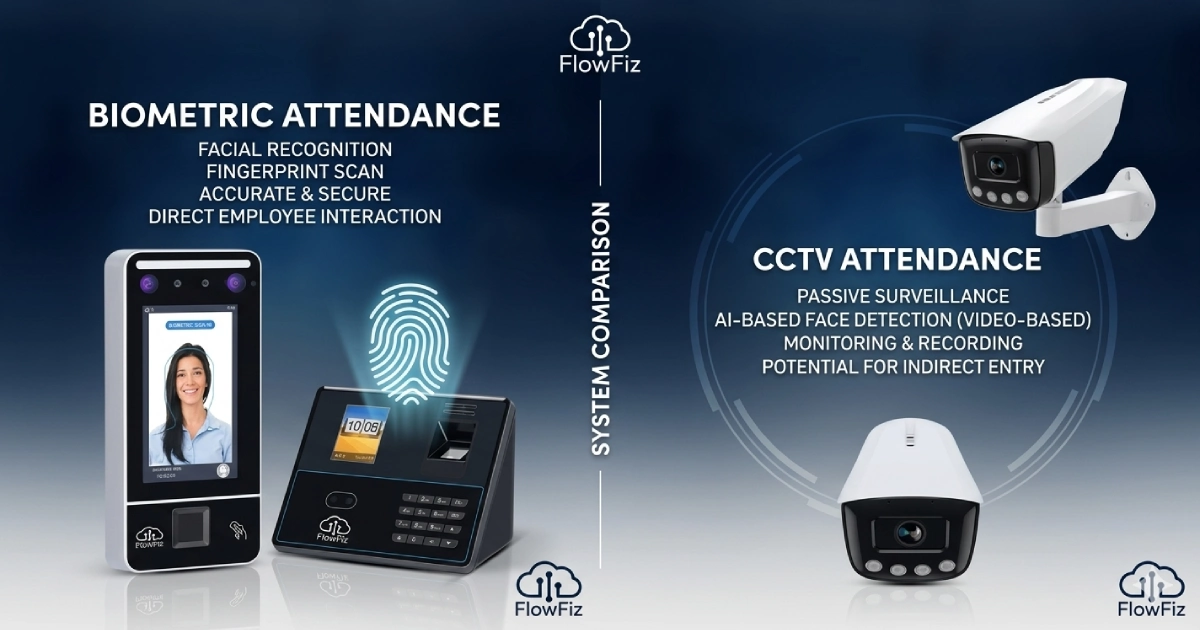
| Quick Answer CCTV attendance VS biometric attendance in a nutshell: AI cameras record check-ins automatically through facial recognition. Staff members walk in without stopping. Biometric systems require every employee to touch a scanner or use a fingerprint reader to clock in. Go with CCTV attendance if your staff count is 50 or more, you have several or busy entry locations, or your company requires office security in addition to time monitoring. Go with biometric attendance if your team consists of fewer than fifty people, you operate one entry point, and give top priority to maintaining low expenses. Both systems keep accurate attendance records, connect to payroll software, and stop buddy punching. Your team size, finances, and the degree of protection required by your company will all help to determine the optimum option. For most evolving Pakistani companies, CCTV attendance offers better long-term benefits. |
Most Businesses Choose the Wrong Attendance System. Here Is What That Actually Costs
Choosing the wrong attendance system is an expensive mistake. Most businesses only find out after the investment has already been made.
One 200-person office installed fingerprint scanners, expecting faster morning check-ins. By day three, the queue began to wrap around the reception. Scans failed repeatedly on workers with rough or damp fingers, HR complaints piled up, and the entire system was replaced within three months.
On the other end, a small team spends money on a full AI camera setup. This includes servers, software licenses, and installation. Several cameras cover a single door. Three months later, the whole system requires a complete replacement. They spend what a mid-sized enterprise would allocate for a problem that a single biometric terminal could have resolved at a fraction of the price.
In Pakistani workplaces where HR oversight is already stretched, the financial impact tends to be larger than payroll reports ever reflect.
The decision between CCTV attendance VS biometric attendance is not just about technology. It is about what your business actually needs. This guide breaks down both systems clearly so you can choose the right one with confidence.
What Is CCTV Attendance?
CCTV attendance is an AI-based system that uses smart IP cameras to automatically detect and recognise employee faces at entry and exit points. The moment a recognised face appears in the frame, the system logs the timestamp in a live online dashboard.
AI cameras use facial recognition and smart tech to log attendance. The system captures video and matches faces to profiles in less than a second. Your team can just walk in naturally without stopping or touching anything. It handles every check-in automatically.
Key Features
- Touchless attendance with zero employee interaction required
- Real-time attendance monitoring across multiple entry points at once
- Remote access from anywhere via a cloud-based dashboard
- Automated attendance logs that feed directly into payroll
- Instant alerts when an unrecognised face appears at an entry point
- Functions as both an attendance system and an office security tool simultaneously
What It Does Well
- No morning queues or bottlenecks at the door
- Liveness detection makes it very difficult to spoof with a photo or video
- One camera covers a wide area and handles multiple people at once
- Combines attendance monitoring and security into a single platform
- Scales as your team grows without adding hardware at every entry point
Where It Has Limits
- Higher upfront installation cost compared to a basic biometric device
- Performance depends on camera quality and consistent lighting
- Camera placement needs proper planning during setup
- Facial data storage must comply with Pakistan’s data privacy requirements
Flowfiz offers AI attendance cameras for any Pakistani workplace. These systems work for small offices or large buildings. Check out our camera options to find the best match for your business.
What Is Biometric Attendance?
Biometric systems use unique physical traits to confirm who is checking in. Fingerprint scanners are the most common choice. Though high-security offices often prefer face or iris scanners instead. Your team saves their details in the system once during setup. The device then matches this data every time they clock in.
To compare with stored data, sensors convert these physical properties into a digital code. This verifies the person’s identity right away. Most devices link directly to payroll software. This makes managing staff data simple for small and growing teams.
Key Features
- Fast and accurate identity verification at the point of entry
- Direct payroll integration with most HR platforms out of the box
- Runs standalone or connects to a wider network
- Supports fingerprint and face recognition on many mid-range models
- Low purchase cost with simple installation
What It Does Well
- Affordable starting point for small to medium teams
- Minimal infrastructure changes are needed to get it running
- Works with most payroll and HR software already in use across Pakistan
- Quick check-ins when entry volume is low
Where It Has Limits
- Fingerprint scanners create queues during morning peak hours
- Shared touch surfaces are a real hygiene concern in busy environments
- Older models can be tricked with fake fingerprint materials
- No real-time monitoring, area coverage, or security functionality beyond the scanner
If a biometric device fits your team size and budget, explore Flowfiz fingerprint and facial recognition devices; reliable hardware, straightforward pricing, and no unnecessary extras.
You May Also Like: What Is CCTV-Based Attendance and How Does It Work?
CCTV Attendance VS Biometric Attendance: The Real Comparison
1. Accuracy and Reliability
Both systems are highly accurate under the right conditions. In indoor environments with controlled lighting, modern AI facial recognition systems regularly exceed 99% accuracy. The NIST FRVT documents this through its ongoing Face Recognition Vendor Testing programme.
Fingerprint scanners work well in a clean office but consistently struggle when fingers are wet, dirty, or worn from physical work. In Pakistan’s factories, construction sites, and food processing plants, this is a daily operational reality, not an edge case. CCTV-based attendance requires no physical contact, giving it a clear reliability advantage in demanding environments.
2. Fraud Prevention and Buddy Punching
When correctly implemented, either system makes buddy punching impossible. By using liveness detection, CCTV attendance adds a more robust layer that renders photo or video spoofing useless. According to the NIST Mobile Threat Catalogue, although advanced biometric devices have made great strides, fingerprint spoofing is still a known flaw in older models.
CCTV-based systems obviously help businesses that appreciate access control and office security beyond just attendance.
3. Data Privacy and Legal Compliance
Both systems collect sensitive employee data. Biometric devices store encrypted fingerprint or facial templates on the device itself. CCTV attendance systems process and store facial data on servers or in the cloud.
Pakistan’s Personal Data Protection Bill (PDPB), now in an advanced stage of legislation, requires businesses to clearly inform employees about what biometric data is collected, why it is collected, and how it is stored. CCTV systems require stronger data governance policies given the continuous video processing involved.
Compliance is not optional, regardless of which system you choose. Skipping this step creates real legal exposure for any employer operating in Pakistan.
4. Cost and Long-Term Value
Biometric devices have a lower entry cost, ranging from basic standalone units to mid-range networked systems. CCTV attendance systems require a higher upfront investment in cameras, AI software, and server infrastructure.
CCTV systems save money over time by integrating attendance and security into one platform. Biometric devices require regular sensor cleaning and occasional hardware replacement, particularly in high-traffic environments.
5. Ease of Use for Employees and HR
Biometric devices are quick to install and easy to operate. CCTV attendance systems need more upfront planning around camera angles, lighting, network setup, and software configuration.
For day-to-day employee experience, CCTV clearly wins. Employees walk through the door, and attendance is recorded. No touching, no stopping, no queue forming at 8:50 a.m. Both systems connect to major payroll platforms through standard integrations, making ongoing HR data management straightforward once everything is live.
6. Scalability as Your Business Grows
Biometric devices work well for small and medium teams. As headcount grows, more terminals are needed at each entry point, which raises both hardware costs and management complexity.
CCTV cameras handle larger volumes simultaneously and cover wider areas with fewer units. For Pakistani businesses planning to grow, or already managing staff across multiple floors and locations, the CCTV VS biometric attendance comparison almost always favours CCTV at scale.
You May Also Like: What are Fingerprint Attendance Machines and How Do They Work?
Full Feature Comparison
| Features | CCTV Attendance | Biometric Attendance |
|---|---|---|
| Employee Interaction | None Required | Required at Device |
| Accuracy Level | Very High | High (ideal conditions only) |
| Fraud Prevention | Very Strong, liveness detection included | Strong |
| Hygiene | Fully Touchless | Shared Contact Surface |
| Office Security Coverage | Yes, built in | Not included |
| Remote Monitoring | Full live access | Reports only |
| Morning Queue Risk | None | High during peak hours |
| Setup Cost | Higher upfront | Lower upfront |
| Payroll Integration | Yes | Yes |
| Scalability | Excellent | Moderate |
| Best For | Large teams and enterprises | Small to mid-size teams |
Still Not Sure Which One Fits Your Business?
You are not alone. The comparison makes sense on paper, but applying it to your own floor plan, team size, and budget is a different thing entirely.
Flowfiz has helped hundreds of businesses across Pakistan get this right, from small offices in Karachi to multi-site operations in Lahore and Islamabad. The team does not push one system over the other. They look at your actual setup and tell you what fits.
Get a free recommendation from the Flowfiz team. No commitment, no sales pressure.
Which System Is Right for Your Business?
Small businesses with a single entry point will find biometric attendance devices practical and cost-effective. A basic fingerprint or facial recognition terminal handles time tracking without any heavy infrastructure investment.
Medium to large enterprises get the most from CCTV attendance. Managing hundreds of employees across multiple floors or locations needs a system that scales without multiplying hardware at every door. CCTV develops alongside your workforce rather than against it.
High-security environments such as hospitals, banks, warehouses, data centres, and government facilities need more than just attendance tracking. CCTV attendance combines access control, security surveillance, and automated attendance into one platform. That makes it the stronger choice wherever office security is a genuine operational priority.
A hybrid approach works well for businesses spread across multiple sites. Biometric devices at quieter internal entry points and CCTV cameras at busy or sensitive entrances, giving you a balance of cost effectiveness and performance. Many Pakistani businesses already run exactly this model.
Flowfiz supports all three setups. Explore the complete Flowfiz solutions to find the right system for your industry, whether you need a single terminal, a full camera setup, or both.
Frequently Asked Questions
Is CCTV attendance more secure than biometric?
For most workplaces, yes. It uses liveness detection to stop spoofing that fingerprint scanners cannot always block. At the same time, it serves as a security system simultaneously.
Can biometric attendance work remotely?
The scanner itself requires the employee to be present. Some systems let HR view reports online. But the actual check-in still happens at the device.
How expensive is CCTV attendance installation?
Cost depends on the number of cameras, software, and network setup needed. It costs more upfront than a basic biometric device. The added security benefit often makes it worth it over time.
Does CCTV attendance connect to payroll?
Yes. Most systems link directly to payroll through online connectors. Attendance data moves to your HR system without any manual work.
What does the CCTV VS biometric attendance comparison look like for factories in Pakistan?
In factory environments, CCTV attendance is almost always the better fit. Fingerprint scanners fail regularly on workers with rough, worn, or damp hands, which is a daily reality on the production floor. Touchless automated attendance removes this problem entirely.
Conclusion
Both systems solve the attendance problem. The difference is in how well each one suits your company now and where you want to take it in the future.
Biometric attendance is a good, affordable beginning point for a smaller group. The CCTV attendance VS biometric attendance decision becomes straightforward for larger businesses, high-security industries, and teams that need touchless attendance, wide-area coverage, and real-time visibility all in one system.
Flowfiz is Pakistan’s most trusted attendance solutions provider, with hardware, software, and local support built for how businesses actually operate here. Whatever your team size or setup, there is a Flowfiz solution that fits.Ready to make the right call? Contact the Flowfiz team today and get expert guidance before you spend a rupee.