

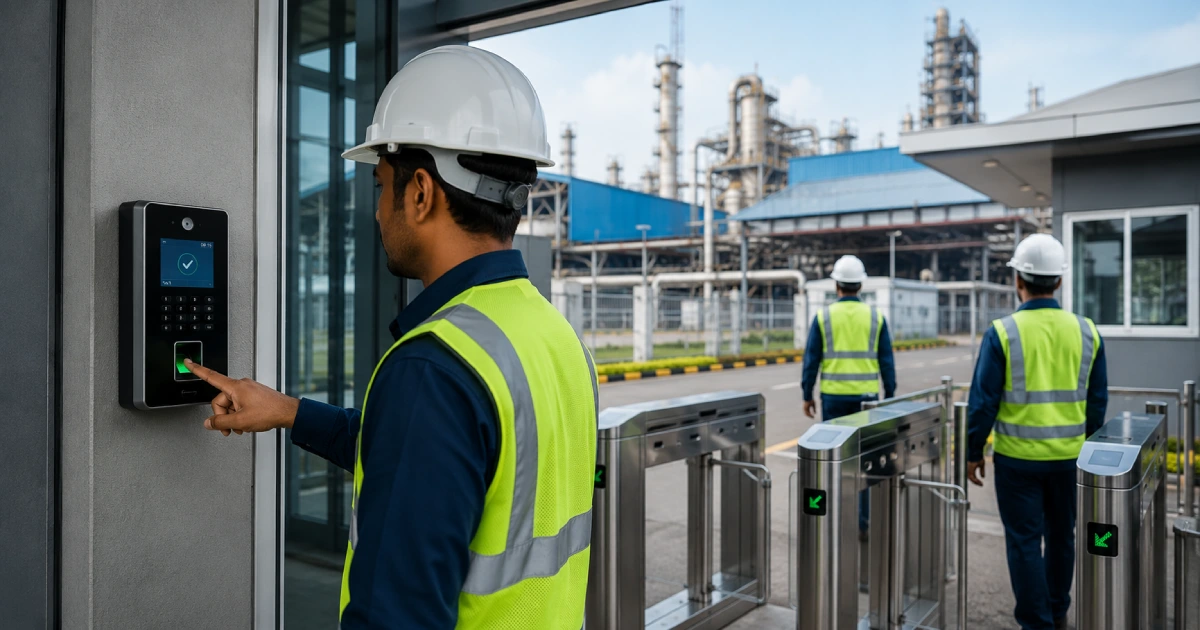
| Quick Answer: Manufacturing plants deal with machinery, raw materials, and hazardous zones every day. Left unchecked, entry points become a source of theft, accidents, or compliance failures. Access control systems for manufacturing plants verify who enters each zone and when, using biometrics, RFID, or turnstiles. The payoff: fewer losses, safer floors, and far less manual security work. |
Walk onto most factory floors, and you’ll count workers, supervisors, contractors, delivery staff, maybe a vendor rep, all moving through at once. Ask the owner who’s actually inside the building right now, and you’ll get a shrug more often than a real number.
That gap is where theft, accidents, and compliance headaches usually start.
Access control systems for manufacturing plants close it by verifying every entry and exit. Karachi garment unit, Lahore chemical plant, Faisalabad auto parts factory — the city changes, but the risk doesn’t. Leave the floor unrestricted, and your machinery takes the hit. So does your inventory. So do the people working the line. This guide explains why factories need strict access control, what can go wrong when plants skip it, and how to pick a setup that actually fits your operation.
What Is an Access Control System in a Manufacturing Setting?
An access control system verifies a person’s identity before allowing them through a gate, door, or restricted zone. On a factory floor, that usually means a biometric scanner or facial recognition, sometimes an RFID card or a PIN pad at the door.
Office access control rarely deals with the same pressure. Factory systems must handle heavy foot traffic, harsh conditions, and multiple risk zones simultaneously. A single gate at the front of the building will not reduce it. Plants need layers: one level of access for the general workforce, a tighter one for machinery rooms, and something stricter still for chemical storage or server rooms.
That’s the real difference between a single gate with a guard and a system that actually holds up: one checkpoint stops nobody once they’re past it. Layers do.
Why Manufacturing Plants Are High-Risk Environments
Factories are not offices. They hold expensive machines, raw materials, finished goods, chemicals, and often a warehouse or loading dock right next to the main building. None of that is open to just anyone.
Unauthorized Entry Can Disrupt Production
A stranger on the floor, or a former employee who still knows the layout, can stop work cold or damage equipment without meaning to. Every one of those interruptions eats into your output for the day.
Internal Misuse Is Also a Security Risk
The threat isn’t always someone sneaking in from outside. Half the time, it’s already on payroll. Employees, contractors, admin staff — they all need different levels of access, and lumping them together is usually where things start going wrong. A cleaning contractor has no business carrying the same entry rights as a machine operator or a warehouse supervisor.
Safety Hazards Make Controlled Access Necessary
Machinery areas, electrical rooms, chemical storage, and loading docks are genuinely dangerous for anyone who has not been trained to work there. Restricting access to these zones protects people first. Protecting assets is really the secondary benefit.
7 Reasons Manufacturing Plants Need Access Control Systems
1. Prevents Unauthorized Entry
Most production facilities still depend on guards to monitor the main gate. A guard can get distracted, feel tired, or miss a borrowed uniform entirely. Deploying biometric tools, facial recognition, or RFID credentials blocks strangers from accessing sensitive industrial zones. The automated system delivers consistent verification every hour of the day.
2. Protects Expensive Machinery and Inventory
Unsecured machine rooms, tool stores, and finished goods areas create easy targets for internal theft. These losses rarely happen all at once. Instead, equipment and inventory disappear quietly over time. The Association of Certified Fraud Examiners has tracked this for years, and manufacturing keeps landing among the industries with the highest median theft losses per case. Controlling access to storage areas and production zones remains a highly cost-effective remedy. Preventing the loss is always more affordable than replacing stolen assets.
3. Secures Restricted and High-Risk Zones
Chemical rooms, control rooms, server rooms, quality labs, and admin offices all need separate access rules from the general shop floor. Grouping everyone under one access level defeats the purpose of having zones at all. A quality lab technician does not need the same clearance as someone stocking the warehouse, and treating them equally only widens your exposure.
4. Improves Employee Attendance Accuracy
Buddy punching remains a common challenge because employees easily clock in for absent friends. Biometric scanners or facial recognition tools eliminate this loophole. As a result, supervisors no longer waste time verifying who actually stood at the assembly line yesterday.
5. Creates Real-Time Entry and Exit Records
Digital logs show who entered, which gate they used, and how long they stayed inside. During a shift change, that is the difference between knowing and guessing. It also means a manager reviewing yesterday’s activity does not have to rely on someone’s memory of who was where.
6. Supports Compliance, Audits, and Incident Investigations
Access records make safety reviews, internal audits, and HR investigations move faster because no one is relying on memory or on a sign-in sheet that no one actually filled out. Workplace injuries remain a real concern in this sector too. Federal data shows manufacturing carries one of the highest nonfatal injury and fatality rates among US industries, and the pattern holds across most industrial economies, Pakistan included. Controlled access to hazardous zones is a documented safety measure, not just a security add-on, and auditors tend to notice the difference between records that exist and those that do not.
7. Reduces Manual Security Workload
Automated verification takes the pressure off guards, HR teams, and supervisors who would otherwise spend hours checking IDs by hand. That time goes back into actually running the plant, rather than standing at a gate matching faces to a list.
Types of Access Control Hardware Suited for Manufacturing Plants
- Biometric security: Fingerprint and facial recognition devices secure critical areas that employ large numbers of workers.
- RFID credentials: Smart card systems represent an affordable way to track standard employee movement across large facilities.
- Speed gates and turnstiles: Physical access barriers maintain orderly single-file traffic at main gates and high-traffic checkpoints.
- AI camera systems: Intelligent video platforms blend instant visual identification with accurate entry logging to maximize workplace security.
Recommended Access Control Setup for Manufacturing Plants
Small factory: Biometric attendance system at the main entrance, with door access to sensitive rooms.
Medium factory: Facial recognition with RFID backup, door controllers, visitor logging, and turnstiles at key entry points.
Large manufacturing plant: Full turnstiles, smart gates, biometric or facial recognition, CCTV attendance, visitor management, zoned access levels, and a central reporting dashboard.
Not sure which tier fits your plant? Our earlier guide on site survey checklists are worth a read before you commit to any hardware.
FAQs
What’s the cost of installing access control in a mid-sized factory?
It depends on your hardware choices and how many entry points you have. A mid-sized plant usually needs a mix of biometric readers and door controllers rather than one expensive system. Ask for a quote based on your actual floor plan.
Can access control integrate with attendance and payroll systems?
Yes. Most modern industrial access control systems sync directly with payroll software, so entry logs feed straight into attendance records without anyone having to retype anything.
Biometric vs. RFID: which is better for factories?
Biometric access is harder to fake and is well-suited to high-security zones. RFID cards are quicker to issue and cheaper for general staff areas. Plenty of plants end up running both side by side.
Can visitors and contractors get temporary access?
Yes! A proper access control system for factories should support temporary passes with time limits and zone restrictions, so a visitor never walks away with more access than the visit required.
Conclusion
Manufacturing plants carry risks that offices simply do not deal with: expensive machinery, hazardous zones, high staff turnover, and constant movement of goods. Strict access control systems for manufacturing plants protect your people, your inventory, and your production schedule simultaneously.
If your factory is still relying on manual checks or an entry system that hasn’t changed in a decade, this is the moment to fix it. Contact FlowFiz for a factory access control setup built around your plant’s actual risk points, not a generic template.