

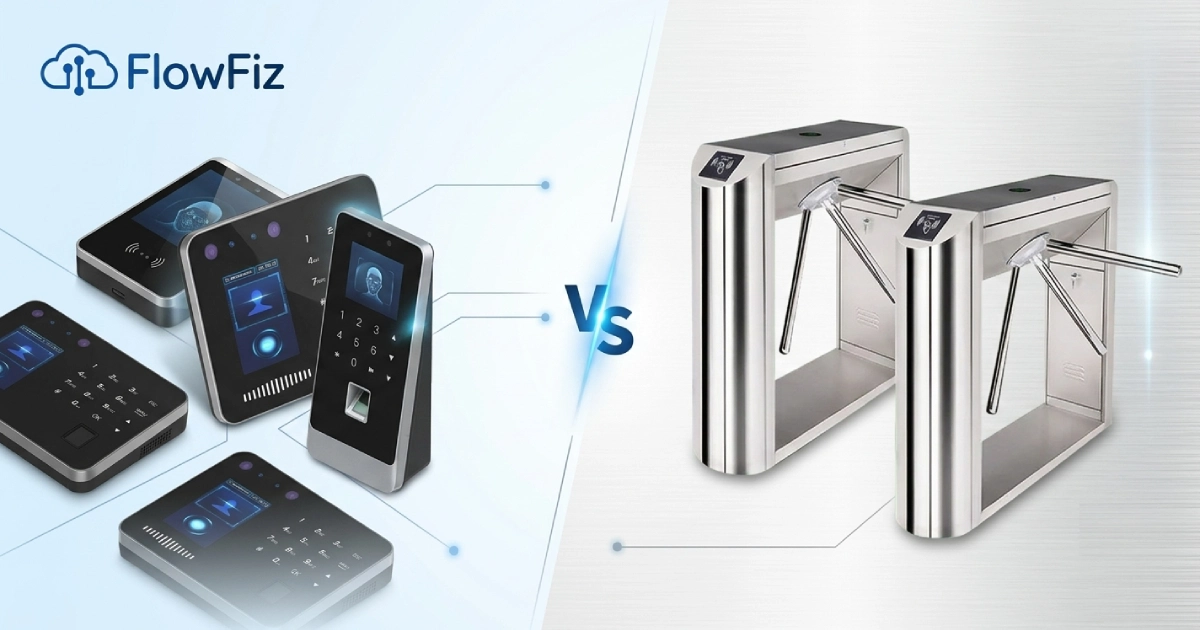
| Quick Answer: Biometric devices vs turnstile systems are the core choice for Pakistani factories upgrading security or attendance systems. Biometric devices verify identity and feed accurate data into payroll. Turnstile systems physically block unauthorized entry. Most factories need both. The right combination depends on workforce size, entry volume, and security risk. |
Your factory gate processes 400 workers every morning. Two supervisors watch the crowd. But nobody actually checks IDs. Three workers clock in for absent colleagues before the first shift starts. One contractor walks onto the production floor without clearance. Your attendance register claims everything looks perfect.
Pakistani factories often operate on a high level of trust, but this habit leaks operational revenue every month. Plugging these leaks requires a systematic approach to security. Facilities benefit from combining both systems to secure entry points. Factory owners need both biometric software and physical turnstiles to manage workforce attendance and facility security. The real decision involves placing each tool effectively within your operation. Factory size and entry volume dictate this layout. This guide breaks down both systems to eliminate guesswork.
What Is a Biometric Attendance Device?
A biometric attendance device reads a unique physical trait and matches that data against a stored record. Fingerprints remain the most common option. Face recognition technology grows faster every year. High-security zones rely on palm vein readers.
A worker presents their finger or face. The terminal matches the input against its database in under a second. A valid match grants access and creates a timestamped record. That record feeds directly into your payroll system. These terminals mount at the main gate or production floor entries. They work independently without needing a physical barrier.
What Is a Turnstile System?
A smart security gate or pedestrian turnstile operates as a strict physical barrier. This system controls crowd flows through an entry point, one person per pass. The gate stays locked until the user presents a valid credential. Once it releases, it immediately closes again.
Turnstiles secure the main gate and locker rooms. The credential might be an RFID card or a PIN. Many sites integrate a biometric reader for enhanced control.
The main types used in Pakistani factories include the following items.
- Tripod turnstiles offer waist-height control for moderate traffic.
- Flap barriers deliver faster throughput for shift changes.
- Swing barriers provide wider lanes for accessible entry.
- Full-height turnstiles deliver perimeter security by fully enclosing the lane.
Check out available guides on turnstile types and tailgating prevention.
Quick Comparison Between Biometric Devices and Turnstile Systems
These two systems solve completely different problems. Understanding where each one stops matters immensely.
| Feature | Biometric Device | Turnstile System |
| Primary function | Identity verification | Physical passage control |
| Stops tailgating | No | Yes |
| Verifies identity | Yes, via fingerprint or face | Requires an added biometric reader |
| Attendance logging | Full identity and time data | Requires credential integration |
| Works without power | Needs battery backup | Fail-safe options available |
| Environmental tolerance | IP65 models available | Outdoor factory use rated |
| Installation complexity | Low wall mount setup | High civil works are needed |
| Throughput per lane | One person every two seconds | Up to forty persons per minute |
| Cost tier | Entry to mid-range | Mid to high |
| Buddy punching prevention | Biometric data prevents sharing | Cards and PINs get shared |
If you only resolve one problem initially, target your largest leak by addressing tailgating or payroll leakage first.
How Factories Actually Use These Systems
Most factories run a combination of both technologies. The layout depends heavily on headcount and facility design. Here are the three setups you will encounter in real industrial deployments.
Standalone Biometric Machine Setup
A single face recognition terminal is mounted at the gate. Workers authenticate before entering. The device logs the time and worker ID without a physical barrier. The weakness reveals itself quickly. A worker authenticates and holds the door open for someone behind them. The system records one entry. Three people walk through. This approach suits small admin blocks where social accountability reduces bypass behaviour. The setup delivers accurate employee time tracking at the lowest cost.
Turnstile Only with RFID Card
An RFID card triggers the turnstile arm. One tap allows one pass. The gate closes immediately behind each person. This layout handles physical flow exceptionally well. The problem lies with identity verification. Workers easily share their cards with colleagues. A worker stays home. A friend taps their card. The entry record still exists, and payroll runs normally. Ghost attendance survives in a different form. This setup works best when perimeter anti-tailgating matters more than absolute headcount accuracy.
The Combined Setup of Turnstile and Biometrics
A biometric reader mounts directly onto the turnstile unit. The worker scans their fingerprint or face. The reader authenticates the identity. The arm releases exclusively for that verified person. This integrated setup addresses both vulnerabilities. The physical barrier blocks tailgating effectively. Biometric authentication permanently prevents buddy punching. Every entry log contains a verified name and a timestamp.
The scale of buddy punching requires serious attention. The American Payroll Association estimates that time theft costs businesses over two percent of gross payroll. For a factory running a ten million rupee monthly payroll, that waste equals 220,000 rupees leaving the building every month. Most operations recover the entire system cost within the first year.
Read more about factory deployments in the access control system guide.
Factory-Specific Challenges Both Systems Must Handle
A system built for an office lobby will fail in a textile mill. Factories impose brutal conditions. These environments place immense stress on both biometric and turnstile hardware.
High-Volume Shift Changes: Four hundred workers arriving in fifteen minutes pose a serious throughput problem. A single biometric terminal creates a frustrating queue. Turnstile lanes with fast readers solve this delay completely.
Dust and Heat Elements Fingerprint sensors clog in dusty environments. Outdoor turnstiles corrode without proper weatherproof enclosures. You must specify your environment before selecting any hardware.
Organized Proxy Attendance Buddy punching plagues large workforces. Biometric integration eliminates this buddy punching entirely, according to data from Nucleus Research. A fingerprint cannot be handed to a friend.
Power Outages and Fail-Safe Settings: Your access system requires a clear emergency protocol. Emergency exits must always unlock automatically during a blackout. Perimeter gates at high-security plants should lock down securely with battery backup.
Check out the FlowFiz Site Survey Checklist to evaluate your facility before finalising any system.
Actual Cost Comparison For Each Setup
Exact prices depend on the brand and the scope of installation. The tiers below give you a practical benchmark for budgeting.
| Setup | Cost Range | Best For |
| Standalone biometric terminal | Entry level | Small offices and restricted zones |
| Tripod turnstile with RFID | Mid range | Budget-conscious sites |
| Tripod turnstile with biometric reader | Upper to mid-range | Medium factories |
| Flap barrier with face recognition | High range | High-throughput shift plants |
| Full-height turnstile with biometric | Premium | High security perimeters |
The hidden cost of bad security drains budgets. A factory with three hundred workers, facing a tiny buddy-punching rate, pays for fifteen ghost shifts daily. That equals real salary expenditure producing zero output. An automated security system pays for itself rapidly.
Which Setup Fits Your Factory Needs
The right hardware depends on your headcount and compliance requirements. No universal answer exists.
Small Factory Under 150 Workers
Recommendation points directly to a wall-mounted biometric terminal. One scanner at the main entry handles attendance accurately within a tight budget. Payback happens fast. The HR team manages the data without dedicated IT support.
Mid-size factory up to 500 Workers
Recommendation leans toward a tripod turnstile with an integrated biometric reader. Throughput becomes critical at this operational scale. A standalone terminal builds long queues. Two tripod lanes at the main gate handle shift flow beautifully. This setup keeps your attendance records highly accurate.
Large Garment or Textile Factory Over 500 Workers
The recommendation calls for multi-lane flap barriers equipped with face recognition. Face scanning processes people faster than fingerprint readers. Flap barriers clear up to forty persons per minute per lane. Integrated access logs make compliance reporting incredibly straightforward.
Factories with Multiple Entry Points
Recommendation requires a hybrid setup across different zones. Not every door carries the same risk level. The main gate demands a heavy physical barrier. A back office entrance might only need a simple fingerprint reader. A tailored factory access control system maps your actual site risk profile.
The FlowFiz Recommendation
FlowFiz rejects the generic package approach completely. Every single site presents unique vulnerabilities. A small plant needs a basic attendance terminal. A massive garment facility requires full-height turnstiles with real-time access logs.
FlowFiz supplies and installs smart gates and CCTV attendance cameras across major Pakistani cities. Every successful deployment begins with a meticulous site assessment.
Contact FlowFiz to get a technical recommendation tailored to your facility.
Frequently Asked Questions
Can a turnstile work without a biometric device?
Turnstiles work without biometric devices. The gate accepts any basic credential, like an RFID card. The barrier controls physical movement seamlessly. The system cannot verify absolute identity without an added biometric scanner.
How many turnstile lanes does a huge factory need?
A flap barrier processes forty people every minute. Three lanes comfortably handle a large shift change window. A professional site survey confirms the exact number based on the gate layout.
Do biometric systems survive dusty factory environments?
Fingerprint sensors struggle in oily conditions. Face recognition cameras conquer dust and humidity effortlessly. These cameras are the ideal choice for heavy-industry floors.
What happens to attendance records during a power outage?
Quality terminals protect data during power outages. Devices store records in local offline memory immediately. The system syncs with the server once power is restored. Battery backups keep gates running through short blackouts.
Which biometric system ranks highest for factories?
Face recognition stands as the best biometric choice for major factories. The technology offers lightning-fast throughput. Fingerprint terminals provide a highly accurate solution for smaller restricted zones.
Do factories need tripod turnstiles or full-height turnstiles?
Tripod turnstiles are well-suited to moderate security zones with active guard supervision. Full-height turnstiles physically enclose the entire lane to stop forced entry. High-value sites require full-height gates to maintain a robust security baseline.
Final Verdict
The comparison between biometric devices and turnstile systems represents a false narrative. These tools perform complementary roles rather than competing against each other. Biometrics reveal who walked through the gate. Turnstiles ensure only one authorised person enters at a time. Most industrial sites benefit from deploying both technologies.
The initial deployment choice depends on your largest current operational vulnerability. A production access control system is tailored to your exact workforce size and site layout. Consult with the FlowFiz team before you spend on hardware.