

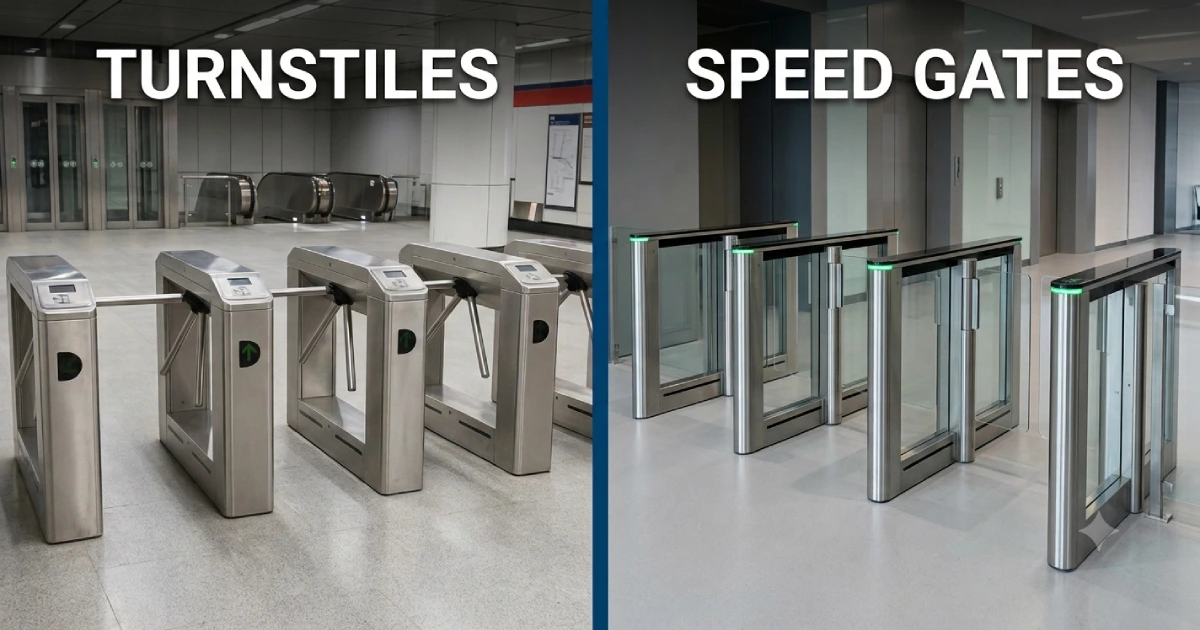
| Quick answer: Turnstiles and speed gates both control who enters a building, but they solve different problems. Turnstiles vs speed gates comes down to physical security versus speed and accessibility. Turnstiles block entry mechanically. Speed gates detect and verify with sensors. Traffic volume, budget, and risk level determine the better fit. |
Your CCTV cameras caught the intruder perfectly. On playback. The next morning.
Every commercial entrance faces the same test. How do you stop unauthorized entry without slowing down your own staff? That question is really at the heart of any turnstiles vs speed gates decision. One option blocks the lane with a mechanical arm or a full-height barrier until a valid credential checks out. The other leans on sensors and glass panels, reading each person and opening only once it confirms who they are. Out in the field, factories with rough, exposed entrances usually stick with tripods or full-height turnstiles because they hold up better. Corporate lobbies in Karachi and Lahore tend to favor speed gates for a fast, modern entrance. The right pick depends on your traffic volume, your budget, and the level of physical restriction your entry point actually needs.
What Is a Turnstile?
Imagine a turnstile as security’s simplest gatekeeper. Turnstiles gates let one person through at a time, then resets. Tripod turnstiles use three rotating arms and work fine in lobbies where security needs to stay fairly light. Waist-high turnstile models take it up a notch, providing offices and gyms with a visible deterrent without going overboard. Then there are full-height turnstile units, which go all the way around and enclose the whole body, so it’s no surprise they’re the go-to at factory gates and stadium entrances. Most turnstiles work alongside a card reader, PIN pad, or biometric authentication device, meaning the arm simply won’t budge until identity is confirmed. They’re mechanical at heart and built tough, holding up under heavy daily traffic with little fuss.
What Is a Speed Gate?
A speed gate is a sensor-driven barrier with retractable glass panels, sometimes called a flap barrier or swing barrier, depending on the panel motion. Infrared sensors detect someone approaching and open the panels only when a valid credential is presented. A sliding speed gate opens sideways, while flap and swing versions pivot or swing instead. These systems suit premium office lobbies, banks, and IT parks where appearance matters as much as function. Many businesses pair speed gates with biometric attendance devices, and facial recognition systems to create a complete entrance-control barrier.
You can read our detailed guide on turnstile types for more details.
Turnstiles vs Speed Gates: Quick Comparison
In short, turnstiles offer greater physical resistance at a lower cost, while speed gates provide faster, more accessible, and better-looking entry control. The table below breaks down the full turnstile vs speed gate comparison.
| Factor | Turnstiles | Speed Gates |
| Physical barrier | Strong (especially full-height) | Moderate, sensor-led |
| Speed per person | Moderate | Fast |
| Appearance | Industrial | Modern, glass finish |
| Accessibility | Limited without a wide lane | Better for trolleys, luggage |
| Upfront cost | Lower | Higher |
| Best setting | Factories, outdoor gates | Offices, banks, lobbies |
A recent ASIS International survey found that tailgating and piggybacking were the most common access-control failures, with 61% of organizations reporting they’d dealt with them firsthand. That one number alone makes the case for taking anti-tailgating sensors just as seriously as the barrier itself when picking a site.
Key Differences Between Turnstiles and Speed Gates
Looks aside, the real difference between turnstile and speed gate systems shows up in six practical factors that shape how your entrance runs day to day.
Design and Aesthetics
Turnstiles look industrial and utilitarian. They suit factory gates, warehouses, and back entrances. Speed gates use glass panels and slim metal housings. They suit reception areas where first impressions matter.
User Flow and Speed
Speed gates clear people faster during office arrival times and shift changes. Turnstiles process one person per rotation, which can create a queue during factory shift changes or large events.
Security Level
Full-height turnstiles are about as far as physical restriction goes at a pedestrian entrance. Speed gates take a different approach, relying on detection and alarms rather than an outright physical block, which suits lower-risk, high-traffic sites just fine. And this isn’t a decision worth getting wrong. IBM’s 2024 Cost of a Data Breach Report pegged the average breach at $4.88 million that year, and more often than not, it traces back to a gap at the physical entry point.
Accessibility
Wheelchairs, strollers, luggage, delivery trolleys, and speed gates simply handle it all more gracefully. If turnstiles are the pick, plan at least one wide lane alongside them to keep the site fully accessible.
Cost and Maintenance
Turnstiles cost less upfront and need simple mechanical upkeep. Speed gates cost more initially, with sensors and glass panels that need periodic calibration and cleaning.
Durability for Pakistani Conditions
Karachi’s humidity, Lahore’s dust, and frequent power fluctuations all test outdoor equipment. Full-height and tripod turnstiles handle heat and dust well with basic upkeep. Outdoor speed gates need weatherproof housings and backup power to perform reliably in Pakistan.
Which One Fits Your Facility?
Once you weigh these factors, the choice between turnstiles and speed gates becomes a matter of matching the system to your facility, not guessing. A quick comparison between turnstiles and speed gates by facility type makes the decision easier.
- Factories and industrial sites: Rugged tripods or full-height turnstiles handle outdoor exposure and heavy daily traffic without frequent servicing.
- Corporate offices: Speed gates match a premium lobby image and keep staff moving quickly during peak arrival hours.
- Schools and hospitals: A mix of affordability and moderate security makes waist-high turnstiles or entry-level speed gates the practical choice.
- Heavy-crowded areas: Airports, railway stations, and stadiums need high lane capacity, favouring speed gates or wide-lane turnstile banks working together.
How to Choose the Right Solution for Your Business
Turn the comparison into a practical checklist before you commit to either system. Our full guide on choosing the right turnstile covers this in more depth.
- Define your security objective: Decide whether you need physical blocking or credential-based detection.
- Measure peak-hour traffic: A site survey tells you how many people pass through during your busiest fifteen minutes.
- Identify the type of users: Factor in staff, visitors, delivery staff, and equipment that need to pass.
- Check authentication methods: Confirm the system supports your card, PIN, or biometric authentication setup.
- Check software and attendance integration: Your entrance system should sync with existing attendance and HR software.
- Evaluate maintenance and local support: Confirm that a Pakistan-based technician can service the unit quickly.
- Compare the complete project cost: Include installation, wiring, backup power, and annual servicing, not just the unit price.
Can Turnstiles and Speed Gates Be Used Together?
Larger facilities often combine both systems. Take a factory as an example. Full-height turnstiles at the outer perimeter handle the heavy lifting on physical security, while a speed gate at the admin building entrance takes over for staff and visitors. That combination gets you rugged protection where it counts and a fast, polished experience where image actually matters. As a bonus, splitting the load across two entry points eases congestion at both ends once shift changes roll around.
Frequently Asked Questions
Are speed gates more secure than turnstiles?
In the turnstiles vs speed gates security question, full-height turnstiles offer stronger physical blocking. Speed gates rely on sensors and alarms, which suit lower-risk, high-traffic entrances better than high-risk perimeter points.
Which is faster, a speed gate or a turnstile?
Speed gates clear people through per lane. Faster turnstiles process one person per rotation, which can slow down during peak shift changes.
Which system is better for preventing tailgating?
Both rely on anti-tailgating sensors and single-person passage design. Full-height turnstiles provide a physical barrier that speed gates do not.
Can speed gates be installed outdoors?
Yes, with weatherproof housing and reliable backup power. Standard indoor speed gates are not built for direct sun, dust, or monsoon rain.
Final Verdict
There is no single winner in the turnstiles vs speed gates debate. Tripod turnstiles suit budget-conscious, low-risk lobbies. Full-height turnstiles suit factories and perimeters that need real physical security. Speed gates suit offices, banks, and lobbies where speed, accessibility, and appearance matter most. Match your choice to your traffic volume, your risk level, and your facility type, not to whichever system looks newest.
Ready to compare options for your site? Contact FlowFiz today for a free site assessment, or explore our full range of security gates built for Pakistani businesses.